Having worked in sterile production environments where contamination control was vital, there were zero exceptions to following the established procedures. Exceptions would invariably lead to unacceptable outcomes. With regards to lock-down and quarantine in relation to SARS-COV-2, there are many exceptions and deviations from the requirements. That will only lead to….you guessed it, an unacceptable outcome. With this in mind, I present to you a brief article on contamination control in sterile production environments. Continue reading →
I wrote the first version of this article in 2014 based on training I developed in 2006. I have updated and reviewed the content to ensure it remains relevant in 2020.
When testing non sterile products, as well as allowed numbers of microbes, there are certain types of microbes that are specified in the regulations as not allowed and still others that can de deemed to be objectionable.
If you work as a microbiologist where you test total microbial aerobic counts (TMAC), total yeast and mould counts (TMYC) and for specific microbes or conduct investigations into the nature of microbes and what impact they may have on the product and the end user, this presentation will benefit you. I will teach you the the following:
What makes a specified organism
What makes an objectionable organism
How to determine if a microbe is objectionable
Risk assessment considerations
The benefits of knowing the differences between specified & objectionable organisms
The PIC/S Guide to Good Manufacturing Practice PE009-13 was published January 1, 2017. Edition 14 was published on 1 July, 2018.
The TGA adopted version 13 of the guide in 2018 and “just given” notice that it intends to adopt the current version of the PIC/S Guide (PE009-14) by July 1st 2020.
So you know what changes, if any you need to make to be in compliance with PE009-14, what are the key differences between these two guidance documents? Continue reading →
The following is an article I placed on LinkedIn and was written as part of my Developing My Writing While Helping Others series.
Paul Yeatman is a microbiologist with over 15 years’ experience in documentation, validation and running investigations in TGA and FDA regulated environments. He has a strong interest in process improvement, documentation, training and developing others. From 9-5 Paul investigates and solves software problems. By night he works on his science chops. He has an arty streak, runs several blogs and enjoys communicating his experiences and knowledge in arenas such as this. Continue reading →
I am a microbiologist with over 15 years’ experience in the pharmaceutical realm. I have a strong interest in regulatory compliance and developing others. Recently I have been working closely with data security. I have an arty streak, have been a work place trainer and have an affinity for computers.
Lately I’ve been thinking of ways to share my knowledge with others outside of my cycling and science blogs and have decided to write 12 LinkedIn posts over 12 months. I will limit the post size to between 500 and 1000 words (1-2 A4 pages). Continue reading →
One way I keep myself up to date with developments within laboratories and related areas is by reviewing draft standards. This keeps me appraised of the current state of affairs, keeps my documentation audit skills fresh and potentially allows me to contribute to the content of standards. For this draft standard, I have some knowledge of IT and IT security so am able to critically review the draft standard and offer comment.
Notes: refer to the conditions for comment stated towards the beginning of the draft standard.
DR AS 2828.2 Health records, Part 2: Digitized health recordsContinue reading →
One way I keep myself up to date with developments within laboratories and related areas is by reviewing draft standards. This keeps me appraised of the current state of affairs, keeps my documentation audit skills fresh and potentially allows me to contribute to the content of standards.
Notes: refer to the conditions for comment stated towards the beginning of the draft standard.
Update 20190103: After proceeding to submit comments, I observed page numbers were required. That is important to note for future reviews. Page numbers added.
DR AS 2243.1 Safety In Laboratories – Part 2: Chemical AspectsContinue reading →
One way I keep myself up to date with developments within laboratories and related areas is by reviewing draft standards. This keeps me appraised of the current state of affairs, keeps my documentation audit skills fresh and potentially allows me to contribute to the content of standards.
Here I step through the draft standard making comments. Where a comment is answered later in the standard, I go back to my original comment and make notes. An uncommented comment is potentially worthy of becoming an official comment on the standard.
From Jan 1, 2017, the PIC/S GMP guide for Medicinal Products V13 will be in effect. In Australia, the TGA requires version 9 is used, though rumour has it, version 13’s going to be adopted soon. If such proposals as this one, which is mainly concerned with herbal “medicine” from the Complimentary Healthcare Council are ratified, then all future PIC/s updates will automatically apply to Australian manufacture. Something to keep an eye on.
Compliance wise adopting PICS/s 13 over 9 is not too big as deal as the PIC/S guide is based on old ICH Q7A guidelines dating from August 2001 and the right and wrongs do not change much over time unless something major takes place. What manufacturers will need to pay attention to are the changes between version 9 and 13, namely:
Chapter 1, 2, 4, 6 and 7 revised – Part 1
Annex 2, 6, 7, 11, 13, 14 and 15 revised
QRM principles in PIC/S GMP added – Part 2
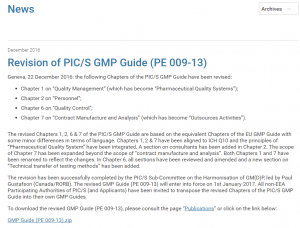
Screen shot of PIC’s news item
Link to guide. (possibly dead) – Google search will find it for you.
Based on the contents of V9, things to review:
Quality Management
Personnel
Documentation
Quality Control
Contract Manufacturing and analysis
You should already be in control of the above areas as otherwise, you’d be having and uncomfortable 3rd party audit experience. The overall principles do not change, just the fine-print.
Annex 1 deals with the manufacture of sterile medicinal products, so not much impact to us there. If you are performing risk assessments and utilising ISO9001, QRM should already be familiar to you.
Did you find this informative or useful? Please consider a small donation so I can expand and improve on what I deliver.