The PIC/S Guide to Good Manufacturing Practice PE009-13 was published January 1, 2017. Edition 14 was published on 1 July, 2018.
The TGA adopted version 13 of the guide in 2018 and “just given” notice that it intends to adopt the current version of the PIC/S Guide (PE009-14) by July 1st 2020.
So you know what changes, if any you need to make to be in compliance with PE009-14, what are the key differences between these two guidance documents? Continue reading →
The current GMPs in Australia adhere to the PIC/S Guide to Good Manufacturing Practice, (PE009-13). This guide was adopted by the TGA in 2018 and the TGA has “just given” notice that it intends to adopt the current version of the PIC/S Guide (PE009-14) by July 1st 2020.
“…I have read PIC/S guidelines, when I was working in Pharmaceutical company. Currently, I am not working in Pharmaceutical company. I would like to keep my knowledge updated about what’s new in regulatory guidelines in Pharmaceutical. Would you please let me know, where can I get copy of new PIC/S??…“
From Jan 1, 2017, the PIC/S GMP guide for Medicinal Products V13 will be in effect. In Australia, the TGA requires version 9 is used, though rumour has it, version 13’s going to be adopted soon. If such proposals as this one, which is mainly concerned with herbal “medicine” from the Complimentary Healthcare Council are ratified, then all future PIC/s updates will automatically apply to Australian manufacture. Something to keep an eye on.
Compliance wise adopting PICS/s 13 over 9 is not too big as deal as the PIC/S guide is based on old ICH Q7A guidelines dating from August 2001 and the right and wrongs do not change much over time unless something major takes place. What manufacturers will need to pay attention to are the changes between version 9 and 13, namely:
Chapter 1, 2, 4, 6 and 7 revised – Part 1
Annex 2, 6, 7, 11, 13, 14 and 15 revised
QRM principles in PIC/S GMP added – Part 2
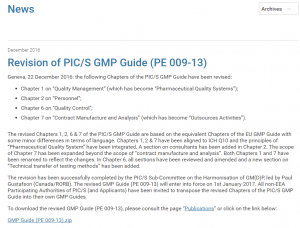
Screen shot of PIC’s news item
Link to guide. (possibly dead) – Google search will find it for you.
Based on the contents of V9, things to review:
Quality Management
Personnel
Documentation
Quality Control
Contract Manufacturing and analysis
You should already be in control of the above areas as otherwise, you’d be having and uncomfortable 3rd party audit experience. The overall principles do not change, just the fine-print.
Annex 1 deals with the manufacture of sterile medicinal products, so not much impact to us there. If you are performing risk assessments and utilising ISO9001, QRM should already be familiar to you.
Did you find this informative or useful? Please consider a small donation so I can expand and improve on what I deliver.
When I was working in the sterile pharmaceutical industry, I reviewed the The Australian Code of Good Manufacturing Practice for Medicinal Products (2002) as part of my self-development. This code was revoked effective from 1 July 2010 and replaced by the PICS Guide for Good Manufacturing Practice for Medicinal Products 2009, as adopted in Therapeutic Goods (Manufacturing Principles) Determination No. 1 of 2009. Here’s the original review.
I have now reviewed the PICS Guide for Good Manufacturing Practice for Medicinal Products 2009, from the stand point of a microbiologist working collaboratively in a sterile pharma plant. What my review does is make note of the salient points and I add comments to some.
Both the revoked 2002 Australian GMP code and the 2009 PICs guide are based on ICH Q&A Good Manufacturing practice Guide for Active Pharmaceutical Ingredients which was last modified in 2000. In 2015 21 pages worth of clarifications were published to clear up some technical questions and to remove ambiguities. Looking at them, I’m not sure why clarification was needed as they all seem straight forward and answerable by anyone experienced working within a pharmaceutical manufacturing environment. This means that despite having “no recent experience” as deemed by some potential employers, my knowledge is still bang up to date. Combine that with my fantastic memory and impressive technical skills and I’d be an asset to your company. Continue reading →