The Erroneous Reporting of Science

I was flicking channels last night and came across an episode of Landline on the ABC.  Being broadcast at the time was an article entitled “Smell The Roses”.

Of most concern to me were the following words I heard shortly after tuning in “…we actually freeze dry the rose petals, they’re taken down to minus 20 to minus 40 degrees, which means it kills off all potential bacteria, diseases…”

As a microbiologist with over 15 years experience within the pharmaceutical industry, I happen to know a thing or two about preservation processes and the above statement is incorrect.

One of the aseptic manufacturing lines where I worked included a freeze drying chamber. Once the product was filled, it passed into this chamber where all the water would be removed at a negative air pressure and at reduced temperature. This turned liquid drugs into a powder which could be stored theoretically forever before use. To make the powder ready for injection, all the administering doctor or nurse needs to do is add water. The process is explained in the diagram below. I apologize for it being a quick and nasty sketch that is not to polished and to scale. Continue reading

Storytelling in Science

The Question posed on LinkedIn.

Many say storytelling in science is a great way to describe complex material in an understandable way for the masses. In this post, I will try to use an analogy to illustrate the complexity of a typical motile bacterial cell. Link to referenced article.

My advice:

Perhaps, as the blog suggested – write an abstract for Joe Public. As well as the article submitted to a journal, perhaps a press release or one page summary in very general terms as to what the study set out to do and what the conclusions were along with possible applications of the new knowledge (unless the study disproved something or was confirming another study).

TOC: At the beginning of a document or at the beginning of each section/chapter?

The Question posed on LinkedIn.

“Somebody asked me why we continued placing the TOC, List of Figures, and List of Tables at the beginning of a document and not having one these at the beginning of each section/chapter.

Several years ago I released technical manuals using section-based TOCs and other lists. However, that was because Word 97 in my PC (Win 98) could not work with large documents. Once I had a powerful enough PC/Word combination, I never did it again.

I mostly update the TOC and the other lists doing Ctrl-A + F9, which brings up the “Update XXX” dialog box for each table. Since I use appendixes, this methods also generates dialog boxes for them as well. I realize that using TOCs and lists at the beginning of each section would make the updating process longer, as more dialog boxes would pop-up.

However, I now ask myself whether it would be advantageous to do such thing, and why. ”

My advice:

At the beginning of the document as it is easy to find. A sub TOC at the start or each chapter could be a bit more informative.

Word is very bad for formatting and tables, but it seems “everyone” besides the graphic design industry uses it or something similarly bad.

Another Job Interview, another unhappy with myself

Today I attended an interview for a science role. I prepared. I researched. I got questions I’d not expected.

Despite my preparation using examples based around the STAR method, my answers were week, being generalisations, or examples that were not fresh in my mind.

The position I was being interviewed for today was basically a team leader role for a bunch of process validation staff. Something I think is suited to my skills, would be sufficiently challenging and keep me busy. My preparation focused on my strengths, how I motivate and lead teams, how I’d developed teams through training. I also focused on my GMP and QMS knowledge, but nothing about that was asked. I’m thinking I should spend a day a week reviewing this sort of stuff so the next time I get an interview, I handle it like a pro. I think I put in a better performance than my last interview, but it was still lacking.

So, here are the questions I was asked, but had to wing…

Q: Give us an example of how you have influenced people and brought them around to your way of thinking…

A: I used some example about how my manager was a chemist and I am a microbiologist. Chemists deal in absolutes, microbiologists deal in probabilities. A weak example of test results, repeat testing and the eventual result being in line with my original expectations and how, over time, my manager was more likely to take on board my advice.

Thinking back, I could have adapted my “how do you motivate people” answer, but that would have still been poor as it is a general answer and not specific.

Q: Give us an example of working on a project team. What was your role and what input did you provide. Who were the other members?

A: I used a site consolidation example I winged. I did not give a strong answer as to what my role was (it was as a microbiology consultant). My contributions were stated more or less and I emphasized how I’d proactively provided microbiology floor plans. I could have been clearer about the other member’s role. I then threw in how I’d lead a regional group of microbiologists through method harmonisation.

Q: Give us an example of when you have mentored and developed staff…

A: I used some example related to an assay falling over. I should have used an example of observing an analyst, suggesting improvements to their technique and how I’d share my scientific knowledge with them. I would have still needed proof that any of that helped them improve.

Q: Give us an example of how you have made process improvements.
A: More weak examples with some specific examples about micro identification methods of assay methods being improved being dragged out of me.

I used “I” a hell of a lot more than “we” to show I did things (as that is what the last interviewers wanted). Applicants will be contacted next week with a yay or nay.

I think the only thing that impressed the two interviewers was how I’d developed a 12 month training plan for my team with a training session each month.
The ABC’s Catalyst and Dodgy Science

Catalyst, a science digest program on the ABC, for the last three weeks has been running stories on the evils of sugar. I suspect a recent push by some nutritionists is the root cause. Not having the program constantly run stories about climate change is a nice change though – there is far much more science going on in the world than studies into humans increasing the mean global temperature over time.

Here’s a summary:

  • 3 weeks ago – diet and tooth decay
  • 2 weeks ago – how sugar is the new evil
  • 1 week ago – how energy drinks are dangerous

Continue reading

Finally Dabbled with Moodle

For a while now I have had the idea to turn a power point presentation I developed a number of years ago into an online learning module. A couple of weeks ago, I set up a domain specifically for playing with Moodle and installed it. I then had to uninstall it as my host’s server’s version of SQL is a bit long in the tooth to support the current version. Once I found a compatible version I unzipped it on my server, set up a database with a couple of test users and had a click around the installation.

I had no troubles creating a course directory structure, but how one went about adding content boggled my mind (it was probably 3 am when I did all this).

This evening, I thought I’d have a fresh look at things and after about 3 hours of referring to my old power point presentation, I’d ported enough information from it to make a fairly decent, but basic and no frills training package on how to control microbes in the home.

Looking at things, if (and when) I have a go at developing some more training modules, most of the fancy formatting will probably be done in Dreamweaver and then copied across to Moodle as I’m not too keen one the provided text editor.

If you want to check it out, click here to learn a little about microbiology. (link’s dead as I’ve removed the site – Jan 2016)

Cover Letters & Resumes

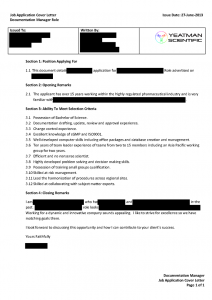
In my quest for employment, I’ve been submitting boring old cover letters to the roles I apply for. The general advice for designers is to send in a fancy pants cover letter. That’s not something I’ve been doing until recently. This week I figured I would start doing that, both for design and science roles.

This last week, I sent off two job application with themed cover letters. One for a design role, one for a science role. I received a call back for the science role (no botching the interview answers this time I hope).

For some “fun” I’ve redacted some information on the doccos. The design role was written and designed as a press release. The science role was created as a controlled document.

Science role cover letter


Design role cover letter

Design role cover letter

In addition to creating themed resume’s I redesigned my scientific resume into a controlled document format which can be customized for the role being applied for. Check out the redacted version here.

Did you find this informative or useful? Please consider a small donation so I can expand and improve on what I deliver.

Anti Ageing Docco

This evening on SBS I watched a documentary about “the truth about” skin ageing. Half of the program appeared to be a plug for Unilever. They had conducted a study into a pill they say rejuvenates skin. This study included a few hundred women (so a fairly small sample size) and made some pretty weak claims based on the good old “before and after” photo. Nobody has independently reproduced or verified the study.

Another section of the docco detailed how “Loreal is the leader in producing artificial skin”. Even without looking up any info, I can tell you that is crap. There are a number of medical companies who are working on creating artificial skin, and most of them use discarded skin as a starter (so grow skin, even if the end product is termed artificial).

In the end, the docco did not deliver. Pleasingly, it did treat the viewer like they had an attention span and told four stories in order, with no jumping all over the place or summarising the entire program after the ad break.

I got the impression the presenter was relaying press releases from cosmetic companies, rather than providing real science. They did mention small sample sizes and whether or not the studies had been peer-reviewed.